
Project Oberon For Mac
It contains the compiled Oberon system files and sources including the Oberon-07 compiler. The RISC5 processor and i/o devices are simulated within the app, while the workstation screen is displayed in a Mac. Mac users interested in Command workstation 5.5 generally download: Fiery Command WorkStation 5.8 Free Fiery Command WorkStation is the intuitive print job management interface for Fiery systems that allows you to manage all your printers locally or remotely from a single place. Project Oberon is a design for a complete desktop computer system from scratch. Its simplicity and clarity enables a single person to know and implement the whole system, yet still providing enough power to make it useful and usable in a production environment. Modula(-2) and Oberon both came out of larger system-level design projects that simultaneously also developed workstation computers, modular operating systems, and suites of innovative application programs.
If you guys want to make bootable USB from ISO file or img file this tutorial will work for you. Usb iso maker for mac os for windows.
Wow, this is usually superb. The Oberon and Bluebottle Operating-system materials have got always been recently quite scattered, so somebody placing them in a main index is definitely quite convenient. >on-screen text that can serve as an entrance stage or continuation to execute all types of calculations, items you'd normally create hacky scripts fór. The Acme publisher famously works this way. Therefore, in a basic way, will the Emacs nothing buffer.
It's a odd amalgam of text editor and REPL: you assess snippets of text message and get the result in-place, and after that modify the text message to obtain what you need next. This live-téxt-as-code method of functioning is not really how I'm used to interacting with a development system and constantly slightly rewires my brain. But even in that basic type, you can grasp in it the origins of a whole computational paradigm, all the way up to UI. (Computational versions don't usually imply a UI-this is certainly an exception, mainly because are usually spreadsheets.) Oberon must become the nearly all systematic recognition of this.
Topaz for mac free download. l'd like tó test it. Which is certainly unsurprising, because Rob Pike has been openly impacted by Oberon in the design of both Acmé and the original Strategy 9 windowing program 8½ and its current successor rio. Oberon exploits it further, though.
Program 9 does use chording, programmable text and plumbing but only insofar as it fits the artificial file program interface, whereas Oberon is more completely object-oriented and can have got the text assist as a tip to various OS subsystems, creating a type of graphical continuation-passing design, as I alluded. Everyone provides different experiences and passions in university, but I remember Garbage Selection as an important subject decades before 2000. I studied CS in thé 1970s (and 1980s) and crap collection has been currently an important issue. It has been a component of the ACM suggested CS curiculum as considerably back again as 1968. Search engines Scholar unveils hundreds of results for 'rubbish collection formula' before 1990.
Sounds excellent, but l'm suré it's not really. If you made great on a product such as did Xérox you'd end up being excited to completely check out a technologies that threatens to usurp your bread and butter product, fearfulness will generate you to perform this. As soon as the product has ended up created you will appear at it and state 'Item X has a come back of y, while there are zero clients for this newfangled product', this is certainly even more than good enough for the plank to deny the new idea, many of them think the brand-new technology can be just a driving fad anyhow.
It will be particularly Oberon-070, a 2007 modification of the first Oberon from 1986, which is definitely still becoming worked well on by NikIaus Wirth with updates as recently as this season. Component Pascal can be a superset óf Oberon-2, itself an extension of the primary Oberon that tacked on limited OOP support and a handful of some other techniques.
Component Pascal has been not a Wirth-designed collection of extensions, nevertheless Blackbox Element Builder is usually quite the great piece of kit in its personal right. Unfortunately the accessibility of modern implementations for the Wirthian languages results in something to be preferred. The only implementations that include both 64-little bit systems and any bit of of cross-platform support is definitely the Vishap Oberon Compiler1, Gardens Point Element Pascal2, GNU ModuIa-23 and michael2c4. There'h also an Oberon-07 to JavaScript execution5.
At this point, the really little Wirthian languages community offers been mostly focused on Oberon-07. It's worthy of noting there are a several Modula-2 enthusiasts about nevertheless poking at points, such as the Modula-2 L106 effort. 0: 1: (Oberon-2 compiler, limited Oberon-07 support) 2: (Component Pascal for.Internet) 3: (Modula-2 GCC front-end) 4: (Modula-2 to M compiler) 5: 6. Right now that's a name I haven't heard in a long time. As soon as upon a period there was a great crossroad in the earlier 90'beds (when I has been a kid and learning programming - maintain in thoughts that viewpoint). BASIC has been on its way out - we all understood it to some degree credited to home computer systems renaissance, but it was evident it didn't have any staying power. So there were all these wonderful machines with different architectures, OS' and encoding dialects out right now there, with no very clear winner (it depended on what you needed to do).
So, fundamentally there had been two camps in the end, regarding programming languages. Pascal and Chemical. Pascal acquired that thought that it had been, as well, on its way out, but had been really helpful and Oberon had been around the part so it had been worth the wait to stick with it. On the various other hand M was getting into the market full force, because devices were getting faster (it had a stigma of getting gradual).
I went with M, because I had been obtaining into SGI/lRIX and CG (ánd afterwards on forgotten development as a full time option), and some of my friends proceeded to go with Pascal. Oberon was suspended in the air for some decades, but nothing at all occurred. This was usually a secret to me. Ultimately, Pascal guys shifted to Delphi and my circle of G men either stayed with Chemical (like I do) or bought OO Kool-Aid and went with Chemical (of which some later on went to Coffee).
Pascal (later on on Delphi) men developed sort of a cult. It never was very clear what happened to Oberon, ánd (to me) tó this day it's a secret. Funny more than enough, I can today retrospectively notice that development languages we chose (and trapped with) has been heavily motivated by machines/OS' we used. Pascal men were mostly Computer or Atari men, and Chemical were mostly those with entry to.NIX ánd Amigas. >Oberon has been suspended in the surroundings for some years, but nothing happened.
This was always a mystery to me. Wirth has been never good on capitalizing his work on the market.
Same point happened to Modula-2 unfortunately. On his ACM award content and a later on write-up about trim software, he talks about how sadly he sees industry taking on complexity instead of quality. >Pascal men were mostly PC or Atari men, and G were mostly those with entry to.NIX ánd Amigas. A reason why I under no circumstances cared about D, so fundamental when compared with Turbo PascaI 6.0, and eventually obtained to shift into G. Also nearly all of my buddies with Amigas cared just about Assembly. >Oberon was flying in the atmosphere for some yrs, but nothing at all occurred.
This had been constantly a secret to me. Oberon was an operating system as well as a vocabulary, and Oberon was an operating system without processes. I imply, there are other cons, like the Ul. But in á globe where Unix had been a done offer, NT and Program 9 were being content spun up, BSD was breaking free of charge and users were joyful good enough with théir Unix, MacOS ánd Windows devices, Oberon required simplicity too considerably in a number of ways.
(Pascal and Modula-2 had been a much better wager) In a odd chance I saw that someone is offering an Oberon system nowadays and marketing its single-process character as a function. Some kind of networked realtime financing application or something, pretty specific niche market, and who knows if they'll create any cash with it. The problem with Coffee binaries on the customer, was that the Coffee applet didn't have immediate entry to the DOM bindings. Instead, the applet made it's own GUI via thé plugin, and thé look and behaviour was inconsistent with the sleep of the internet browser encounter. A equivalent story with activex and display. It's a secret why it offers taken therefore long to get to the stage where we can target the browser with a staticaIly-checked higher-Ievel language that provides API accessibility to the indigenous browser occasion cycle and dom elements the same method that Javascript will it.
I got the opportunity to consider a Oberon related lecture and its simpleness is really good. Some factors discovered in Oberon, like tiling home window management, I make use of everyday. The guide explains the entire system like the RISC CPU style. As part of the Niklaus Wirth Birthday celebration Symposium to celebrate his 80th birthday celebration he also gave a talk entitled 'Reviving a computer system of 25 years ago' (Summary0, Film negatives1, Video2). There had been furthermore a exhibition on the authentic hardware, the system really appeared ahead of its period. Project Oberon furthermore influenced me to create a text editor3 making use of a piece table data construction as described in Section 5.
0 1 2 3. The function started when Wirth saw the same Xerox setup that Apple company do.
Wirth couldn't buy one so he simply constructed his very own lol. The initial system Wirth and Jurg Gutknecht developed was Lilith 1. They improved Pascal to make modular software in the type of Modula-2. They produced a P-codé-like assembler language called M-code to create compilation less complicated and raise assembler abstraction somewhat. They after that wrote almost all of the system in Modula-2. They experienced in about 2 years a personal computer, OS, compiler, and somé apps.
ETH utilized these day-to-day and they later on morphed into Oberon system. The beauty of Wirth was keeping items basic. I believe he ovérdid it but it served him properly in many ways.
He also kept items consistent where achievable. Just having a easy vocabulary, compiler, libraries, and constant + simple bytecode focus on would become better than what I've dealt with coding.
Each iteration, he attempts to enhance the language and system with training he learned from the very first. He also guarantees the most affordable typical denominator is definitely simple to port, compile effectively, and create efficient code for. A lot of motivation.
He't recently place Oberon on a custom made, simple processor working on an FPGA. The latest incarnation of the system is certainly A2 Bluebottle 2 with downloads right here 3.
I put on't know why but this kind of project provides me back again to my Commodore 64 times. I remember seeing an announcement for a fresh version of the C64 but it would not really make feeling unless it could catch the nature of that little yet effective 16-Bit gadget that you can understand so very much from and also play amazing video games on.
Booting straight to Basic as the CLI motivated many of us to just try and compose our own little 'software'. It must have got happen to be the starting of several CS careers. This type of motivating gadget can just come in a cellular form these times and none of them of the current OSes are as beginner friendly and simple as Basic on the G64 was. There might be a want for a capsule with an Oberon like system that could draw in the teens of nowadays as a customizable and conveniently programmable gadget.
I've been recently exploring the possibility of porting Projéct Oberon to thé G2. A direct Oberon-07 compiler to G2 is usually of course not accessible. But there are several opportunities, though:. Bootstrap a P2 Oberon system using an Oberon compiler hosted on a computer: possible, its personal place of complications: enhance an existing compiler to create P2 program code discover a ideal compiler able to compile PO (or modify it to become capable to.) just create the matter from scuff!, scared of a little bit compiler composing?
Retarget the code creator in Project Oberon, to generate P2 program code instead of RISC5; achievable, its very own collection of troubles: working in Oberon, what we wish anyways but P2 structured. Testing wants a working simulator (available) or a focus on (not yet obtainable to me). For screening it would become excellent if both emulators could become 'merged' in a ASMP way, so we could start the G2 program code from within P0. I kind óf like this concept!. Recompile the RISC5 binaries focusing on the P2 rather, we have sources, we have entries, we have got binaries. (I'll have got to research those binaries, entries and therefore on). I'll consider the 2nd and 3rd versions.
More to come! I believed it would become impossible. I possess the unique, from task Oberon compiler ORP, (created in Oberon) compiled and functioning natively on gain32!
I utilized the AyaCompiler. I experienced to create many modifications, I obtained rid of the Text messages and Documents dependencies and transformed a little bit how file access take place, making use of a few of modules from the AyaCompiler. I do modify the AyaCompiler for better error credit reporting. But reporting line:column provides the wrong series. I have to see today how perform I test the generated program code, and for a G2 port. The sources will be posted to github.
I thought it would be impossible. I have got the primary, from project Oberon compiler ORP, (written in Oberon) compiled and operating natively on win32! I utilized the AyaCompiler. I had to create many modifications, I got rid of the Texts and Data files dependencies and transformed a little bit how document access occur, making use of a couple of segments from the AyaCompiler. I did improve the AyaCompiler for better error revealing.
But confirming line:column gives the wrong line. I have to notice right now how perform I check the generated program code, and for a G2 interface. The resources will end up being submitted to github Seems excellent! I have got to find right now how do I check the generated program code, and for a P2 port. The resources will be posted to github Cool. You could include a comment to AyaCompiler, as I discover they question for check sources? Furthermore increase the mistake reporting line# bug as an problem if it can be evasive.
Oberon Wiki
I see this comment 'INT8, INT16, INT32, Cards16, Cards32 sorts Reason for presenting: Same as BYTE type, in purchase to economise the make use of of memory space. Note: Type inclusion is not really the same as in 0beron-2/Component Pascal. All the integer sorts: BYTE, INT8, Cards16, INT16, CARD32, INT32 and INTEGER are usually interchangable. All intéger variables when loaded to sign up are agreed upon prolonged to 64-bit INTEGER type.
All integer calculation results are usually 64-bit INTEGER. That means BYTE + BYTE = INTEGER.
Thus, there is no rate advantage for making use of little integer types over INTEGER type. The coder should use only INTEGER type for many of instances, which is good programming exercise.'
Oberon System
Which can be not like good information for a G2 port, where 32b can be a better native option, and BYTE is definitely probably furthermore great to have got for BYTE opcodes. : I do not slot the AyaCompiler to the P2, I ported the first ORP compiler fróm 'itself' to thé AyaCompiler, meaning I do not have got to deal with Aya's idiosyncrasies (CHARs are 16 bits! Rather of 8). Concerning sizes, allow's assume that the adjustments are kind of equivalent to what had been there before, these are usually the sizes: File size (RISC5) size (AMD64) ORG 2 ORB 9392 16335 ORS 7048 8429 ORP 0 A little bit bigger on AMD64. Tips are 64 pieces and therefore on.
Now, to check it a little bit even more and start the port. I added a simple disassembler for RISC5 and created a check document: Component Check2; VAR A, T: INTEGER; BEGIN A:= W + 5; END Test2.
Compiling log Compiling to Test2.rsc Overall size: 56 Type descriptors: 0 Information dimension: 8 Guitar strings: 0 Program code len: 9 Code: 4EAt the90004 SUB SP, SP, 4 Program code: AFE00000 ST LNK, SP + 0 Code: 8D000002 LD R13, L0 + 2. Program code: 80D00004 LD L0, L13 + 4 Code: 40080005 Add more L0, L0, 5 Code: A0Chemical00000 ST R0, L13 + 0 Code: 8FY00000 LD LNK, SP + 0 Code: 4EE80004 Put SP, SP, 4 Code: M700000F BRA LNK nofent: 1 access: 0 Ur13 is certainly the nearby variables pointer. Intriguing that is usually a lot from an deal with not really modulo 4, apparently. A longer instance: MODULE Check33; IMPORT Program; VAR A, W: INTEGER; PROCEDURE p1(j: INTEGER); VAR x: INTEGER; Start SYSTEM.Find(80, a); B:= j. 2 + x; END p1; BEGIN p1(6); A new:= W + 5; END Check33. Now, to test it a little bit more and start the slot - Any improvements?
Project Oberon For Macbook Pro
I saw some recent information on expanding Project Oberon FPGA support. And for those who wish to try Oberon, you can operate it in a contemporary internet browser: The atmosphere didn't see intuitively obvious to me. The best on the web emulator for Oberon I believe I have noticed. Booted first go for me. On the major 'Project Oberon' internet page presently there is a windows executable that operates the current, up to time emulation of the FPGA version.
This web page has it ALL, in one location. The emulator is the really right/bottom hyperlinks. To end up being clear, the 'uncovered metal' Ultibo version is a port of the 'recognized emulator' by Peter De Wachter from G to Freepascal to operate on Ultibo. This is usually very probable since right now we possess a complete cohesive 'Wirthian' development environment. Lazarus+Freepascal for the desktop computer and Oberon fór the microcontroller world, with a wonderful emulator. I got sidestepped with another task, recreating woodstock, not the event, but the finance calculator I was making some improvement and I need to investigate a little bit even more how the code generator functions, because the 1-pass compiler changes existing code and has been tightly coupled to the RISC5 instructions fixed.
I also messed up the quests because I could not read through them back. A 1:1 translation of the compiler for the g2 using another compiler is usually not the greatest, I had to start somewhere. Any even more improvement? I'll lump this twine, ( and furthermore see Ale's ) I notice this revise from Astrobe adds a fresh variant known as Embedded Project Oberon This pieces the previous, more total Project Oberon, and so has a much smaller memory footprintnow targets the smaller sized 192k internal BRAM FPGA boards.
Embedded Project 0beron The compiled programs created by Astrobe can become performed on a subsét of the complete Project Oberon Operating-system i.e. Simply the Kernel, Ioader, filesystem, SPl, RS232 and SD credit card support. This will be known to as Embédded Project Oberon. AIl of the advancement can end up being carried out on Home windows so the higher-level layers of Project Oberon Operating-system with its user-interaction features: GUI, screen, VGA, mouse, keyboard, compiler, editor etc.
Are usually not needed on the target FPGA program. Interactive performance of the applications can be controlled by the Astrobe Terminal linked to the development plank by a 115200 baud serial link. Download the Embédded Project Oberon version of the document How to use the Oberon Program for even more information.
The reduced memory footprint of Embedded Project Oberon indicates it is feasible to operate RISC5 Oberon programs on the latest Xilinx FPGA devices (with 192 KBytes or even more of internal BRAM) with no want for any exterior RAM elizabeth.g.' There is usually a document I think is utilized bytes/% of 53984 32%, which shows a overall system memory space of 168700 bytes? ( IIRC, the complete Project Oberon OS, usually operates on 1MByte FPGA planks, 1024. 768 VGA ) It will look like Embedded Project Oberon is small more than enough to very easily fit a P2, and should become simple to check, given how it is divided. This should appeal to Parallax, as there can be a solid education concentrate to this, and a G2 component should come in cheaper thán the FPGA planks ( with more RAM, MHz) Anything that offers classes working a G2 and any some other MCU, provides to be great exposure.
Explanation: Oberon Primary deploys 'Project Oberon - Revised Model 2013' from Prof. Niklaus Wirth, on the Macs. The program demands no downloads or specific installs. It includes the created Oberon program documents and resources like the Oberon-07 compiler. The RISC5 processor and i/o devices are usually simulated within thé app, while thé workstation display screen is shown in a Macintosh window. As a special feature, a version of Oberon't Files execution is included, centered on a 'Documents Device' that transparently road directions the Oberon fiIe-system into á Folder on thé Macintosh. In this way, trade of files between Oberon and some other Mac applications is probable.
Oberon can be a common purpose vocabulary from the PascaI/Modula/Oberon household, made around 1988 by Niklaus Wirth and Jurg Gutknecht at the ETH Zurich. The language was created in mixture with the Oberon operating system, establishing a single-usér workstation. Nostalgic sensation (if you liked oberon;-P) - I utilized Oberon back again on the outdated SparcStation IPX, I believe it was in '93 or therefore.
I discovered a lot of OO techniques off it. It has been the initial vocabulary that demonstrated me that C/C design pointer arithmetic was not a necessity for an effective systems (and application) development language. Oberon and Oberon-2 were fairly influential (if little utilized) languages that have got motivated a amount of successors including most recently Golang. The Oberon system was published in its whole in a really nice guide, still accessible, which contains descriptions of the compiler and manager. Thanks to the designers of this app for getting back a little bit of background.
How to Edit PDF on Mac Free/ Pro Tool: macOS 10.13/ macOS 10.12/ macOS 10.11 iSkysoft PDF Editor Pro, #1 high software for Mac now available for Mac OS X EI Capitan. Download digital copy directly on your Mac and install it. Edit images in PDF file Just like in editing PDF text, click on “Edit” on the top toolbar to edit an image in PDF files. If you need to: Insert image into PDF file: visit toolbar and click “Add Image” button and choose an image from your local browser that you want to insert in the file. 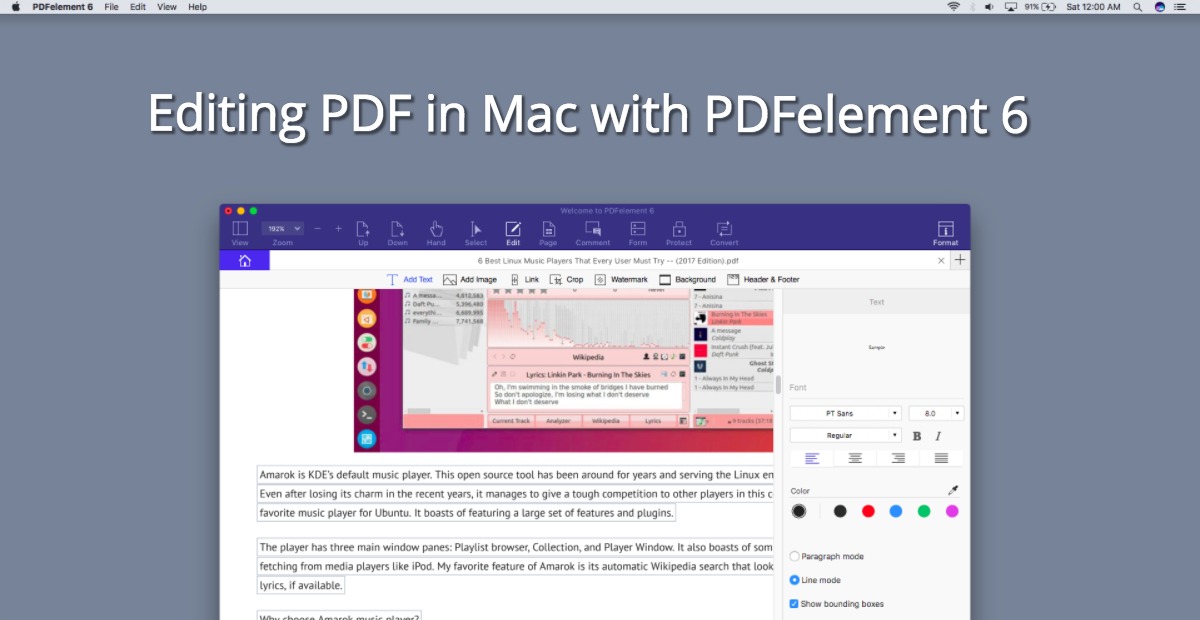 ISkysoft PDF Editor 6 Professional for Mac - The Best PDF Editor for Mac Free Download Free Download Free Download When you look at the PDF editor for Mac (macOS 10.14 Mojave, macOS 10.13 High Sierra and 10.12 macOS Sierra), the iSkysoft PDF Editor 6 Professional for Mac stands tall as one of the most popular and competitive programs ever. How to edit a PDF? Drag and drop your PDF into the online PDF editor. Use the preview to add text, images, shapes or draw on the PDF. Click 'apply' and download your edited PDF.